Interested in seeing a demo?
Fill out the following information (please ensure you provide some detail on the problem you are looking to solve or the Messagepoint product you are interested in).

Customer Communications Management (CCM) software helps organizations create, personalize, manage, and deliver customer communications across print and digital channels.
CCM stands for Customer Communications Management.
Customer communications is a general term that refers to many different types of communications across all industries and sectors.
Payment confirmations, appointment reminders, account statements, direct marketing emails, invoices, and correspondence about an account can all fall under the label of “customer communications.”
That broad definition can make it difficult to determine whether Customer Communications Management software, also known as CCM software, is right for a specific requirement or need.
Some software review sites add to the confusion. They use a broad definition of CCM and group tools that don’t align with how the industry defines Customer Communications Management software.
Customer Communications Management (CCM) software is a well-established and well-defined software market segment. It grew out of document composition solutions that targeted print communications in the 1990s.
CCM has been the subject of industry analyst reviews and forecasts since the early 2000s.
The tech industry analyst firm Forrester defines CCM software solutions as:
“Software used to compose, format, personalize, and distribute content to support physical and electronic customer communications and improve the customer experience.”
Forrester notes that CCM software supports content types such as letterhead, invoices, correspondence, marketing materials, policies, statements, and welcome kits.
Most often, CCM solutions manage complex communications. These communications are highly personalized outbound communications that contain personal account or transaction data, text, and graphics.
The content may vary by demographic, such as region, or by product or customer profile.
Organizations can produce these communications in batch jobs, such as monthly billing cycles. They can also trigger them on demand, such as a claims status update.
CCM solutions can also support sales, customer service, and support teams that need to provide personalized communications to an individual using a common template.
Today’s CCM platforms empower organizations to send communications and content across a variety of channels, including:
CCM software manages mission-critical communications and information, particularly for organizations operating in regulated industries like financial services, insurance, healthcare, and utilities.
The right CCM solution supports several strategic initiatives.
CCM software enables consistent, relevant communications tailored to individual preferences and needs.
This helps organizations improve customer understanding, satisfaction, and loyalty.
AI can also support sentiment, reading level optimization, plain language, and translation. These capabilities help improve communication effectiveness.
Modern CCM platforms put communications management in the hands of business users.
They also use intelligent approaches to content management to reduce manual effort and accelerate time-to-market.
The most advanced platforms go further. They apply agentic AI to take on the work of CCM directly by planning and executing tasks across content, rules, and templates.
This helps teams shift effort from execution to strategy.
For regulated industries, CCM software helps ensure that required disclosures, disclaimers, and brand standards appear correctly where required.
Approval workflows, audit trails, version control, and content reuse also help organizations maintain control over regulated communications.
Customers may receive a printed statement, an email, or a link to a web page.
Across those channels, CCM software helps ensure accurate information and consistent content and branding.
This matters as organizations expand communication channels and customer expectations move toward faster, more personalized digital experiences.
CCM software commonly manages complex, personalized, and regulated communications such as:
These communications often include customer-specific data, required legal language, product-specific content, regional variations, and channel-specific formatting.
CCM solutions have been in the market for decades.
It isn’t unusual to find organizations relying on outdated solutions that no longer meet the needs of a modern workforce or customer base.
Legacy systems often require IT intervention for content, data, and rules updates. They also tend to rely on outdated approaches to content and template management.
Many legacy systems also provide limited options for digital channel support.
Modern CCM solutions offer significant advancements for both the user experience and the customer experience.
Organizations sometimes confuse CCM software with CRM, document generation, or marketing automation software.
These technologies may connect to customer communications processes, but they serve different purposes.
CRM systems manage customer relationships, sales activity, service activity, and interaction history.
CCM software manages the creation, personalization, approval, delivery, and governance of customer-facing communications.
Document generation tools assemble documents from templates and data.
CCM platforms support a broader set of requirements, including complex personalization, content reuse, compliance workflows, omnichannel delivery, template variation management, and control over large communication inventories.
Marketing automation platforms manage campaigns and promotional journeys.
CCM platforms manage a wider range of operational, transactional, servicing, and regulated communications. These communications often require strict accuracy, auditability, and governance.
Today’s customers expect personalized, relevant communications delivered across the channels they choose.
As organizations expand communication channels and increase personalization, content volume and complexity grow rapidly.
Traditional CCM processes remain slow, manual, and resource-intensive.
To keep up, organizations need a modern approach.
Messagepoint is built for this reality. Its cloud-based platform enables business users to create, update, manage, and orchestrate communications across print and digital channels without heavy reliance on IT.
Powered by MARCIE, Messagepoint’s proprietary AI platform, Messagepoint uses agentic, generative, and traditional AI to automate the work of managing content, rules, and communications.
The result is faster execution, greater accuracy, and seamless delivery of communications across channels.
Messagepoint’s intelligent content hub eliminates the need to duplicate and manage the same content across individual document templates and different systems.
This supports customer experiences across multiple channels while reducing redundant work.
When content needs an edit, Messagepoint enables business users to make the change once and have the update instantly appear across all related touchpoints and channels.
This helps ensure speed, consistency, and compliance.
This content-centric approach is especially important for regulated organizations that manage large libraries of communications with shared disclosures, legal language, product details, brand content, and regional variations.
Messagepoint has pioneered the use of AI for customer communications.
Its focus is helping customers streamline and automate the processes of content management, migration, optimization, and translation.
As the first CCM solution to integrate AI, Messagepoint leads the market in its ability to accelerate content optimization processes while taking advantage of enterprise-grade security and controls.
Powering these capabilities is MARCIE, Messagepoint’s proprietary AI engine.
MARCIE leverages agentic AI, generative AI, and traditional AI to automate the work of managing content, rules, and communications. It also helps deliver optimized customer experiences across all channels.
MARCIE enables Assisted Authoring, which helps teams optimize content for clarity, sentiment, reading level, plain-language compliance, and translation inside Messagepoint’s cloud-based content hub.
MARCIEAssist, MARCIE’s agentic AI capability, automates content operations within Messagepoint.
Users describe what they want to accomplish in plain language through a chat interface.
MARCIEAssist interprets intent and executes supported actions across content, rules, and communications while keeping users fully in control.
Every action runs within strict governance boundaries, with full audit trails and rollback.
This allows teams to move faster without giving up the oversight regulated communications demand.
Modern CCM teams need to reduce the number of templates and touchpoints under management without sacrificing personalization or compliance.
Messagepoint’s variation management capabilities help organizations manage similar communications more efficiently by using master touchpoints, variants, and sub-variants.
This reduces redundant template management and enables teams to update shared content more efficiently across related communications.
For organizations managing hundreds or thousands of similar communications, this helps reduce effort, improve consistency, and simplify change management.
Messagepoint also helps organizations improve translation processes for customer communications.
Instead of translating one full document at a time, Messagepoint breaks communications down into individual content components.
Teams can reuse these components across communications and channels.
This enables teams to translate content objects once instead of multiple times, which reduces redundant work and improves consistency.
Messagepoint’s AI-powered translation capabilities help teams translate content faster, use glossaries for terminology alignment, and apply Translation Accuracy checks.
These checks validate that the meaning and structure of content is preserved across language versions.
Organizations need to accelerate time to market, reduce costs, and manage communications across print and digital channels.
For many teams, the old operating model of farming out communications management to print service providers no longer works.
Messagepoint enables organizations to take back control of their communications with a cloud-based approach that creates optionality in managing vendor relationships.
This allows teams to centrally control content and communication timelines across all channels while retaining the freedom to choose the right partners.
Messagepoint is an award-winning CCM solution recognized as a leader by industry analysts covering the space, including IDC, Aspire, QKS, and Celent
CCM is more than document generation. It is a core function of customer experience strategy for organizations that need to manage complex, personalized, and regulated communications at scale.
As customers expect more personalized and seamless interactions across channels, having a modern, intelligent CCM solution becomes essential.
The right solution doesn’t just help you manage your communications. It does the work of managing them with you, applying AI to handle complexity behind the scenes so your team can focus on the experience your customers actually see.
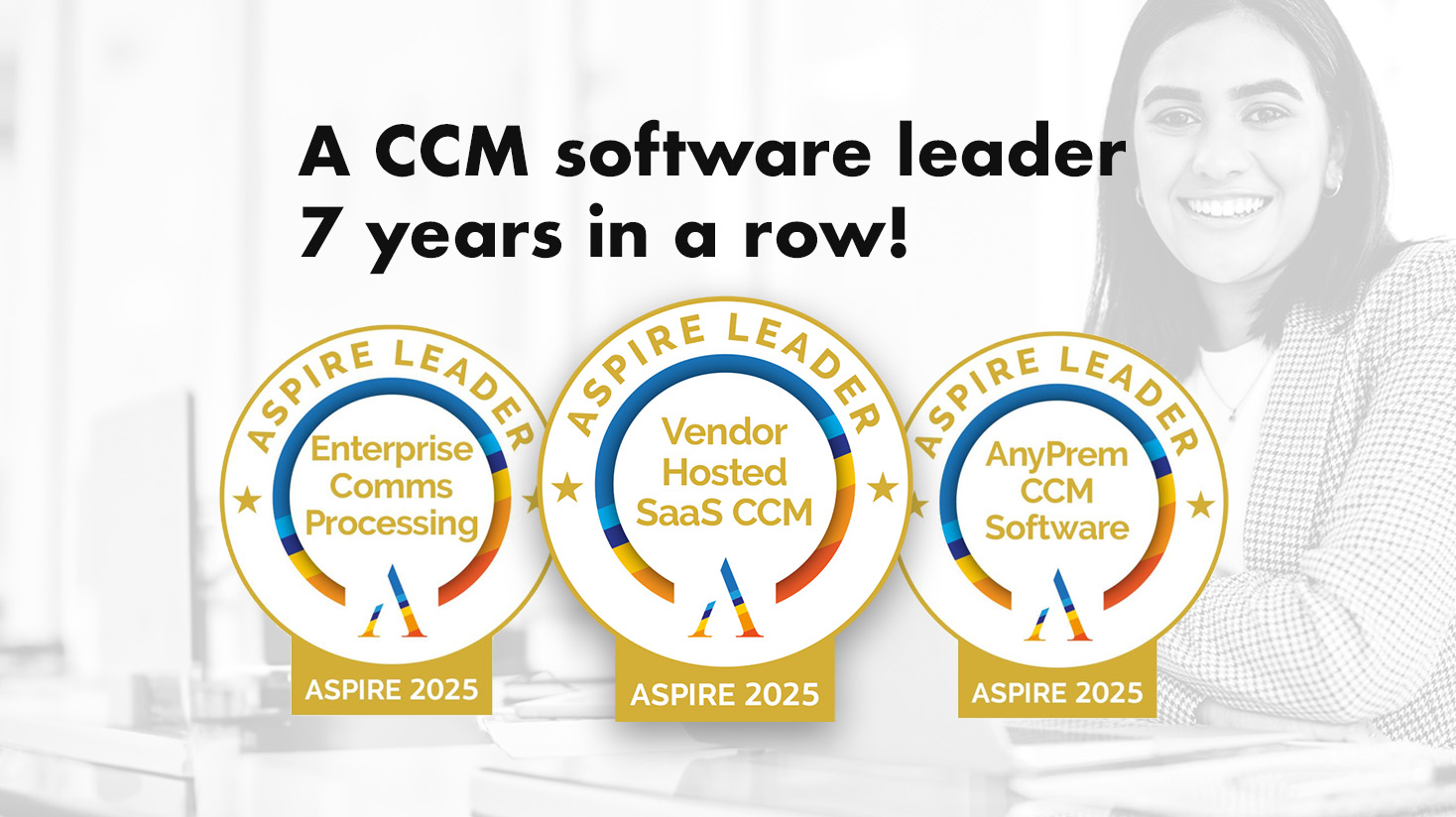
Messagepoint was recognized as a Leader in the 2025 Aspire CCM-CXM Technology Vendors Leaderboard for the seventh consecutive…
Read the whitepaper
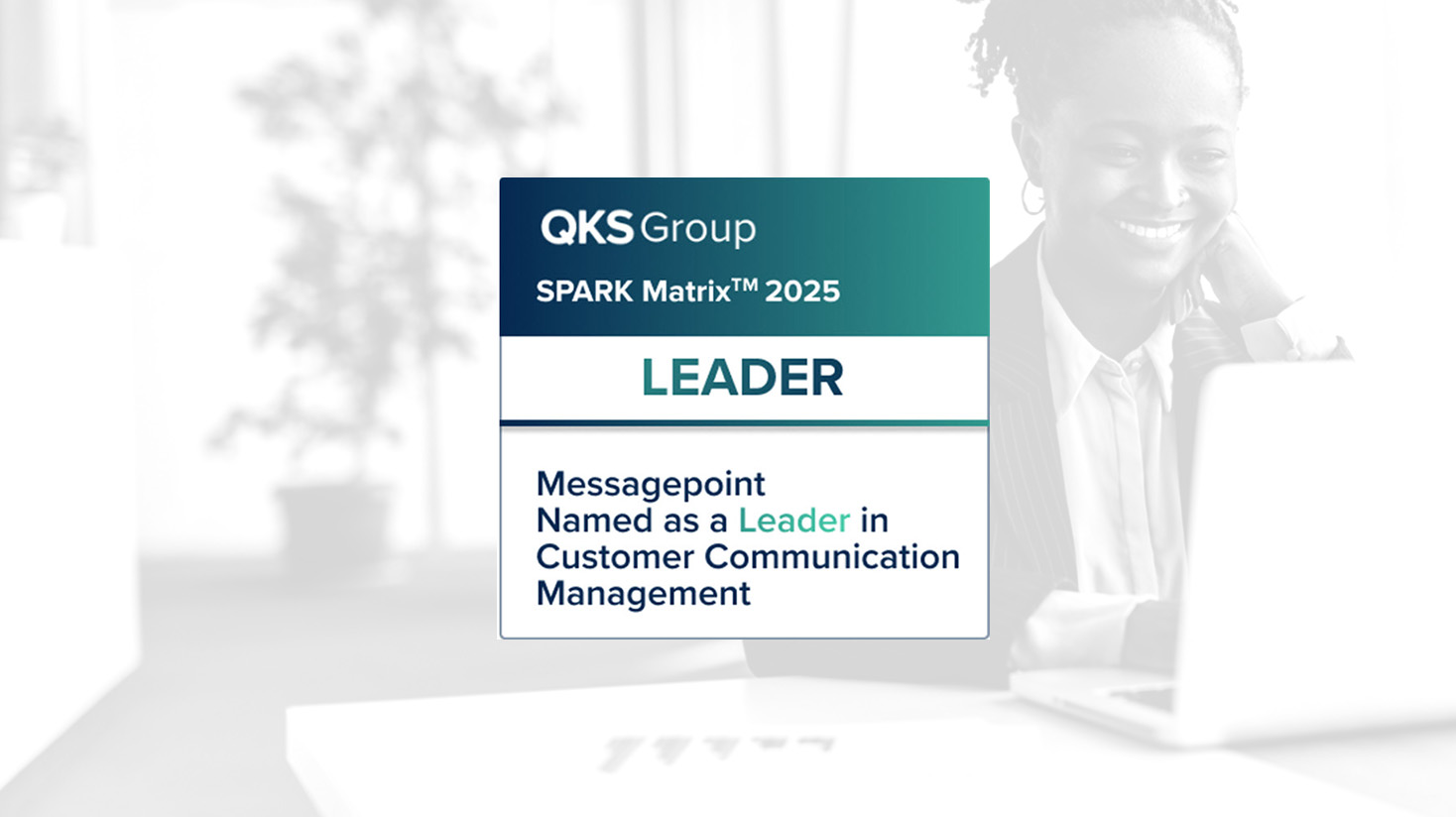
Messagepoint has been named a 2025 SPARK Matrix™ Technology Leader in Customer Communication Management (CCM) by global research…
Read the Article
 " alt="Messagepoint Logo" title="Messagepoint Logo"/>